

How Long Does TMS Treatment Take? A Realistic Timeline for Recovery
How long is a TMS treatment? Learn typical session length, overall timeline, and how treatment is structured from start to finish.

TMS isn’t a one-day treatment, and it’s not meant to be. If you’re considering it, one of the first practical questions is how much time it actually takes and how that fits into daily life. TMS follows a structured schedule, and the full timeline depends on the treatment plan, the condition being addressed, and how the brain responds over time.
This guide breaks down what that schedule typically looks like, how long each session lasts, and what to expect from start to finish so you can understand the commitment before getting started.
A closer look at how TMS is evaluated and planned, including what a first appointment involves, is available at https://www.charakcenter.com/.
TMS Duration: The Short Answer
TMS is commonly used for treatment-resistant depression and obsessive-compulsive disorder. Clinical data suggests that around 60% of patients who did not respond to other depression treatments experience a meaningful response to standard TMS protocols.
A standard course typically lasts 4 to 6 weeks, with sessions scheduled five days per week. Some protocols may extend slightly longer depending on clinical response or the specific condition being treated.
Each session usually takes about 20 to 40 minutes, depending on the type of TMS used. Newer protocols, such as intermittent theta burst stimulation (iTBS), may reduce session time to as little as 3 to 10 minutes, while still following a similar overall treatment schedule.
In total, patients can expect 20 to 36 sessions over the course of treatment. This frequency is intentional. Repeated stimulation over time is what helps drive measurable changes in brain activity associated with mood regulation.
Most people are able to continue their usual daily activities before and after each session, as TMS does not require anesthesia or recovery time.
What a TMS Treatment Timeline Actually Looks Like (Week by Week)
TMS is delivered in a structured sequence, but clinical changes tend to emerge gradually. Viewing the process week by week helps clarify how treatment is introduced, maintained, and adjusted over time.
Week 1: Mapping and Getting Started
%20for%20Depression%20Brain%20Mapping.png)
The first visit to a TMS clinic includes brain mapping to identify the treatment area and set stimulation intensity, often based on the motor threshold. This typically takes 20 to 30 minutes and guides all TMS sessions.
Patients may feel a tapping sensation as the TMS coil delivers magnetic fields through controlled TMS pulses. Mild headaches can occur early but usually improve. Mapping may also consider functional MRI and mental health history, especially in major depressive disorder and obsessive-compulsive disorder.
Weeks 2 to 4: Consistency Phase
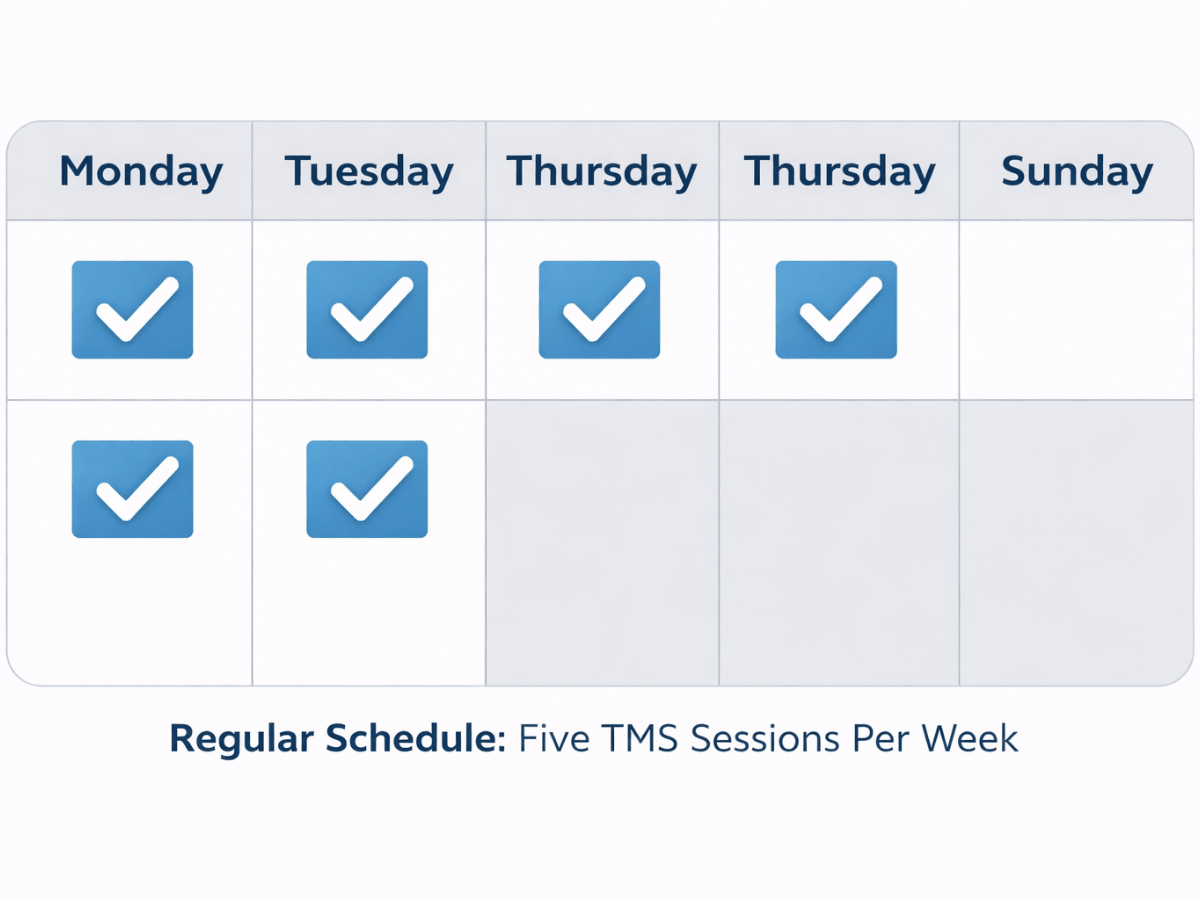
Treatment follows a regular schedule, usually five sessions per week. Session structure and duration remain consistent.
Clinical changes at this stage are often limited or subtle. Some individuals report early shifts in mood, sleep, or attention, while others do not notice measurable changes yet. Both patterns are common.
Weeks 4 to 6: Noticeable Shifts

Symptom improvement may become more apparent during this phase. Reported changes can include improved mood regulation, increased energy, or better concentration.
Response timelines vary. Not all patients experience changes within the same window, and a slower onset does not indicate lack of effectiveness.
After Week 6: What Happens Next?

At the end of the initial course, some patients complete treatment. Others may continue with additional sessions or move into a tapering phase, where session frequency is gradually reduced.
Next steps are based on clinical response and ongoing evaluation, with the goal of supporting more stable symptom control over time.
TMS follows a defined schedule, but individual response patterns remain variable across the course of treatment. Ongoing research continues to inform how treatment protocols are refined based on individual response.
Why TMS Treatment Length Isn’t the Same for Everyone
Clinical data suggest that around 60% of patients with treatment-resistant depression experience a meaningful response to standard TMS protocols, even after limited success with other treatments.
TMS is delivered using a standardized schedule, but the total duration can vary based on clinical and individual factors. Treatment length is adjusted to reflect response rather than following a fixed endpoint.
Key factors include:
- Condition being treated: Protocols differ across mental health conditions such as major depression, bipolar disorder, bipolar depression, and post-traumatic stress disorder. Options like deep transcranial magnetic stimulation (deep TMS) may be used depending on the condition and treatment site.
- Baseline symptom profile: Symptom severity, duration of depressive symptoms, and prior use of antidepressant medications, talk therapy, or other depression treatments can influence how quickly patients experience significant improvements.
- Individual neurobiological response: TMS uses an electromagnetic coil or magnetic coil to deliver magnetic pulses to specific brain regions, often the dorsolateral prefrontal cortex, to support changes in brain chemistry and mood control. The brain involved responds at different rates across individuals.
- Adherence to the treatment schedule: TMS is delivered over multiple sessions, typically five per week. Consistent attendance supports cumulative effects, while missed sessions may extend the timeline.
- Ongoing clinical assessment: During the initial treatment, providers monitor response and may adjust the plan. Some patients transition to maintenance treatments to help manage symptoms or reduce relapse risk.
In practice, TMS duration is guided by observed response and ongoing evaluation, rather than a fixed number of sessions for every patient. Care coordination can support treatment planning and help adjust timelines based on individual needs.
Frequently Asked Questions
What Happens If You Stop TMS Early?
TMS therapy or transcranial magnetic stimulation (TMS) works through repeated treatment sessions that stimulate nerve cells in targeted brain regions. Stopping early may limit symptom relief and lead to a partial response. The treatment team may adjust the plan to help complete the full treatment course when possible.
Do You Need Maintenance Sessions After TMS?
Not always. Some patients benefit from maintenance TMS or ongoing maintenance sessions to help prevent symptom relapse, especially in treatment-resistant depression or major depression. Others do not require additional care.
Are There Shorter TMS Protocols?
Yes. Accelerated TMS protocols deliver multiple treatment sessions per day, shortening the timeline. Repetitive transcranial magnetic stimulation with shorter session formats may also be used.
These options depend on the condition and clinical assessment.
Is TMS a Long-Term Commitment?
No. Transcranial magnetic stimulation TMS is a non-invasive treatment delivered over a defined period. Unlike electroconvulsive therapy, it does not require anesthesia. Some patients may repeat treatment if depression symptoms return.
Can You Miss a Session During TMS?
Occasional missed daily sessions can happen, but consistency matters. Frequent gaps may reduce effectiveness or extend the treatment course, as repetitive TMS relies on cumulative effects.
Putting the TMS Timeline Into Perspective
TMS follows a defined schedule, but the experience is not identical for everyone. Most treatment plans are completed over several weeks, with sessions designed to build on each other and support gradual, measurable change.
Treatment length may vary based on individual factors, but the overall approach remains consistent: repeated sessions, ongoing evaluation, and adjustments based on clinical response. To take the next step, you can call 1-855-4CHARAK (1.855.424.2725) or fill out the contact form to request a clinical evaluation and discuss appropriate treatment options.